- 8920675323
- 9971118455
- Uttar Pradesh, India

Measuring ROI on Business Software Investments

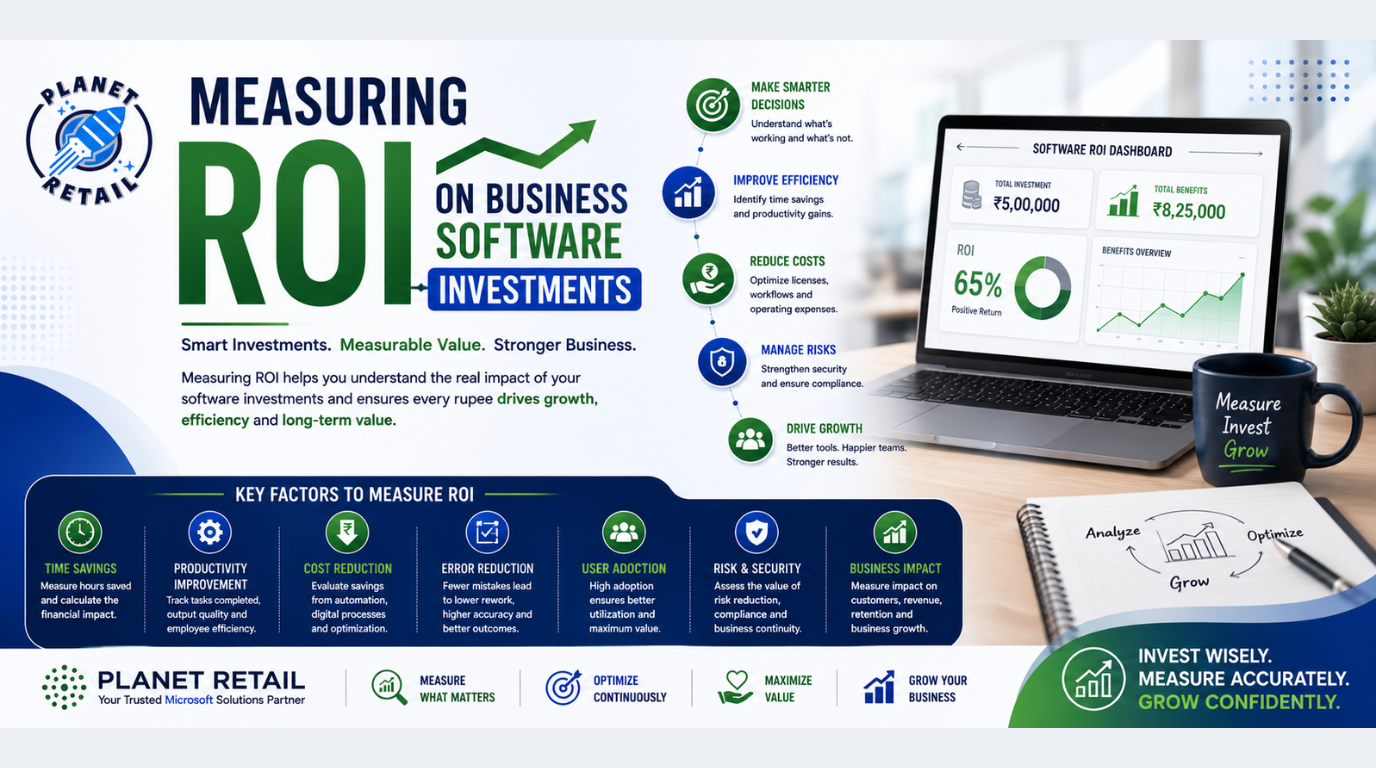
Businesses invest heavily in software to improve productivity, automate processes, strengthen security, manage data, and support growth. But purchasing software is only the beginning.
The bigger question is:
Is the software actually delivering a measurable return on investment?
Measuring the Return on Investment (ROI) of business software helps organizations understand whether their technology investments are creating real business value. It also helps decision-makers identify underused tools, optimize licensing costs, and make smarter technology investments in the future.
What Is Software ROI?
Software ROI measures the financial and operational benefits generated by a software investment compared with its total cost.
A simple ROI calculation is:
ROI = (Financial Benefits − Total Investment Cost) ÷ Total Investment Cost × 100
For example, if a business invests ₹5 lakh in software and generates ₹8 lakh in measurable benefits, the investment has produced a positive return.
However, software ROI isn’t always limited to direct revenue. Time savings, reduced errors, lower operating costs, improved security, and better customer experiences can also contribute significant value.
1. Define Clear Business Objectives
Before measuring ROI, determine why the software was purchased.
Possible objectives include:
- Reducing operational costs
- Increasing employee productivity
- Automating repetitive processes
- Improving customer service
- Reducing errors
- Strengthening cybersecurity
- Improving collaboration
- Supporting business growth
Clear objectives make it easier to determine whether the software is delivering the expected results.
2. Calculate the Total Cost of Ownership
The purchase price or subscription fee is only one part of the investment.
Consider the complete Total Cost of Ownership (TCO), including:
- Software licenses
- Subscription fees
- Implementation costs
- Migration expenses
- Training
- Integration
- IT support
- Maintenance
- Customization
- Hardware requirements
Understanding the complete cost provides a more accurate picture of ROI.
3. Measure Time Savings
One of the easiest ways to measure software ROI is by calculating how much employee time is saved.
For example, suppose an automated workflow reduces a task from 30 minutes to 5 minutes and employees perform it 500 times each month.
The time saved can be converted into an estimated financial value using the relevant labor cost.
Over a year, these small savings can become substantial.
4. Track Productivity Improvements
Software can help employees accomplish more within the same amount of time.
Useful productivity metrics include:
- Tasks completed per employee
- Processing time
- Project completion rates
- Response times
- Customer requests handled
- Documents processed
- Sales activities completed
Comparing these metrics before and after implementation can reveal whether the software is improving productivity.
5. Measure Cost Reduction
Technology can directly reduce operating expenses.
For example:
- Cloud solutions can reduce infrastructure costs.
- Automation can reduce manual processing costs.
- Digital documents can reduce printing and storage expenses.
- Collaboration platforms can reduce travel costs.
- License optimization can eliminate unnecessary subscriptions.
Track these savings over time to calculate the financial impact.
6. Measure Error Reduction
Manual processes often create errors that require additional time and resources to fix.
Software automation can reduce:
- Data-entry mistakes
- Duplicate records
- Calculation errors
- Incorrect orders
- Documentation errors
- Compliance issues
To measure the impact, compare error rates before and after implementation and estimate the cost of correcting those errors.
7. Evaluate Employee Adoption
A software solution can only deliver value if employees actually use it.
Track:
- Number of active users
- Login frequency
- Feature utilization
- Workflow completion
- Adoption by department
- Training participation
Low adoption may indicate that employees need additional training, better processes, or a different technology solution.
8. Measure Customer Impact
Software investments can also improve the customer experience.
Consider metrics such as:
- Customer response time
- Support resolution time
- Customer satisfaction
- Repeat purchases
- Customer retention
- Order processing time
If software helps employees respond faster and deliver better service, that improvement can contribute to long-term revenue growth.
9. Measure Security and Risk Reduction
Some software investments don’t generate obvious revenue but protect the business from potentially significant losses.
Cybersecurity solutions can help reduce the risk of:
- Data breaches
- Ransomware
- Account compromise
- Business downtime
- Data loss
- Regulatory penalties
The value of these investments can be assessed by considering the risks they help mitigate.
10. Review Software Licensing
Businesses often purchase more licenses than they actually need.
Regular software audits can identify:
- Unused licenses
- Inactive users
- Duplicate subscriptions
- Underused applications
- Users on unnecessarily expensive plans
Optimizing licenses can improve ROI without requiring additional software purchases.
11. Compare Before-and-After Performance
One of the most effective approaches is to establish a baseline before implementing the software.
Record metrics such as:
| Metric | Before Implementation | After Implementation |
|---|---|---|
| Processing Time | 4 hours | 1 hour |
| Manual Errors | 8% | 2% |
| Monthly Operating Cost | ₹2,00,000 | ₹1,60,000 |
| Customer Response Time | 24 hours | 6 hours |
This comparison makes the impact of the investment easier to understand.
12. Consider Long-Term Business Value
Not every software benefit appears immediately.
Some investments provide value through:
- Scalability
- Business continuity
- Better employee experience
- Improved security
- Faster decision-making
- Easier collaboration
- Future automation opportunities
Businesses should consider both immediate financial benefits and long-term strategic value.
Common Mistakes When Measuring Software ROI
Organizations often make several mistakes when evaluating technology investments.
Focusing Only on Purchase Price
Ignoring implementation, training, support, and maintenance can produce an unrealistic ROI calculation.
Measuring Only Revenue
Software can create significant value through productivity, cost savings, risk reduction, and efficiency—even when it doesn’t directly generate revenue.
Ignoring Adoption
A powerful software platform won’t deliver expected ROI if employees aren’t using it effectively.
Not Establishing a Baseline
Without pre-implementation data, it becomes difficult to accurately measure improvement.
Never Reviewing the Investment
Business requirements change. A software solution that was valuable two years ago may no longer be the most cost-effective option today.
A Practical Software ROI Framework
Businesses can use a simple five-step approach:
1. Define
Identify the business problem and expected outcome.
2. Measure
Establish baseline performance before implementation.
3. Implement
Deploy the software with appropriate training and support.
4. Track
Monitor usage, productivity, costs, and business outcomes.
5. Optimize
Adjust licenses, workflows, training, and technology based on the results.
This creates an ongoing process rather than a one-time ROI calculation.
The Role of AI and Automation
AI and automation are making software ROI even more measurable.
Modern platforms can provide insights into:
- Workflow performance
- Employee productivity
- Application usage
- Process bottlenecks
- Customer interactions
- Time savings
These insights help organizations identify where technology is generating value and where additional optimization may be required.
Conclusion
Measuring ROI on business software investments is essential for making smarter technology decisions. Organizations should look beyond subscription costs and consider productivity gains, time savings, cost reductions, improved customer experiences, security benefits, and long-term business value.
The most successful businesses don’t simply ask, “How much does this software cost?”
They ask:
“What measurable value does this software create for our business?”
At Planet Retail, we help businesses make informed technology and Microsoft licensing decisions by aligning software investments with business requirements, productivity goals, security needs, and budgets. With the right approach to measurement and optimization, businesses can turn technology spending into a measurable driver of efficiency, growth, and long-term value.